> For the complete documentation index, see [llms.txt](https://docs.mediarithmics.io/llms.txt). Markdown versions of documentation pages are available by appending `.md` to page URLs; this page is available as [Markdown](https://docs.mediarithmics.io/collaboration/plan-and-integrate/understand-data-collaboration-concepts/clean-rooms.md).

# Clean Rooms

The layers a Data Clean Room partnership is built from: Collaborative App, Clean Room Template, and Clean Room.

## What a Clean Room is

A **Clean Room** represents a partnership between you and one of your partners. It is the actual collaborative space where the two of you share datasets, match them, and act on the result - without either side handing the other raw data.

In each Clean Room, you can:

* Compute the overlap between your customer base and your partner's audience, without either side sharing raw data.
* Discover which of your partner's segments concentrate your best-performing customer profiles.
* Activate a media campaign on your partner's inventory, targeting shared users (or excluding them).
* Measure the incremental sales, reach, or conversions generated by a joint campaign.

Every Clean Room is instantiated from a **Clean Room Template**, which determines what you and your partner can do inside it.

## How data collaboration works in the platform

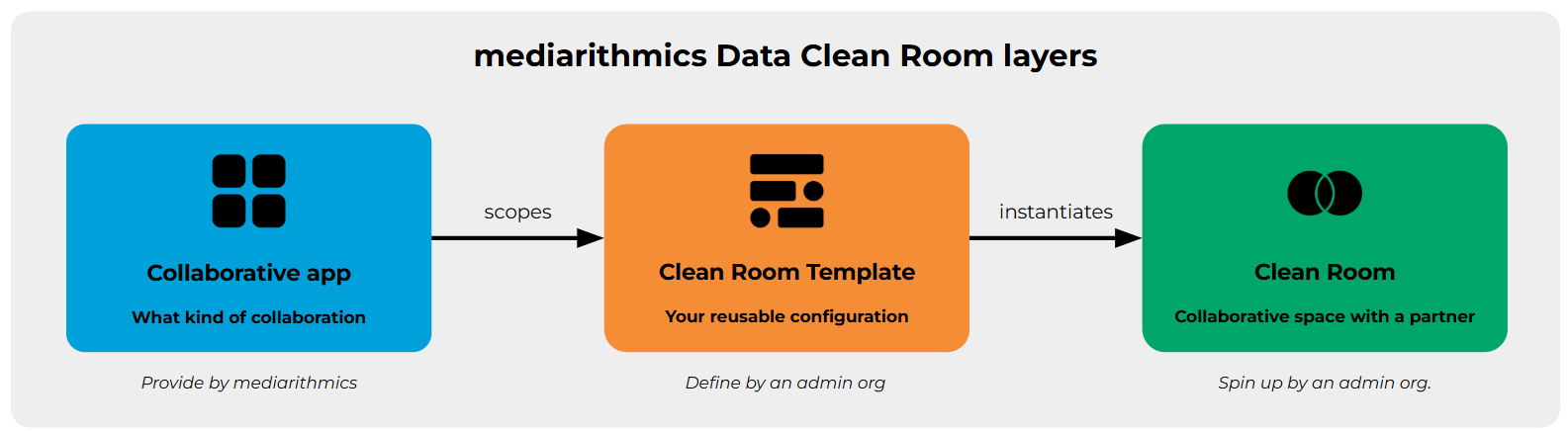
Every collaboration in the Data Clean Room module is built on these layers:

<figure><img src="https://1328282722-files.gitbook.io/~/files/v0/b/gitbook-x-prod.appspot.com/o/spaces%2FA53jQEyPfbbnUyaAsTnT%2Fuploads%2Fgit-blob-d7f6ddaf38491e6edbb27fc0077bdf245c811a86%2Fclean-room-layers.png?alt=media" alt="Collaborative App scopes a Clean Room Template, which instantiates a Clean Room"><figcaption><p>Collaborative App → Clean Room Template → Clean Room</p></figcaption></figure>

* [**Collaborative App**](https://docs.mediarithmics.io/collaboration/plan-and-integrate/understand-data-collaboration-concepts/collaborative-apps.md) - a pre-configured envelope that defines *what kind of collaboration* can happen inside a Clean Room. Collaborative Apps are provided out-of-the-box by mediarithmics.
* [**Clean Room Template**](https://docs.mediarithmics.io/collaboration/plan-and-integrate/understand-data-collaboration-concepts/clean-room-templates.md) - your organisation's reusable configuration of a Collaborative App. It carries the governance rules and default settings that will apply to every Clean Room you spin up from it.
* **Clean Room** - the actual collaborative space where you and a specific partner collaborate on data.

This layered approach ensures that every new partnership follows a predefined, governed pattern, and shortens partner setup time.

### Clean Room collaborators

The types of collaborators in a Clean Room are **Administrator** and **Partner**.

| Role                      | Tasks                                                                                                                                                                                                                                |
| ------------------------- | ------------------------------------------------------------------------------------------------------------------------------------------------------------------------------------------------------------------------------------ |
| **Administrator (Admin)** | Initiate the creation of a Clean Room by picking a Clean Room Template and inviting the Partner; share datasets; perform dataset matchings; activate common or exclusive users on authorized activation platforms; generate insights |
| **Partner**               | Share datasets; perform dataset matchings; analyze generated insights                                                                                                                                                                |

{% hint style="success" %}
A given organisation can act as Administrator of one Clean Room while acting as Partner of another. Roles are scoped to each individual Clean Room, not to your organisation as a whole.
{% endhint %}

## Next steps

* Pick the [Collaborative App](https://docs.mediarithmics.io/collaboration/plan-and-integrate/understand-data-collaboration-concepts/collaborative-apps.md#what-a-collaborative-app-is) that matches your use case.
* Set up your organisation's [Clean Room Template](https://docs.mediarithmics.io/collaboration/prepare-your-environment/manage-your-clean-room-templates.md).
* [Create a Clean Room](https://docs.mediarithmics.io/collaboration/prepare-your-environment/create-a-new-clean-room.md) from that template and invite your first partner.

## Related pages

<table data-view="cards" data-search="false"><thead><tr><th></th><th></th><th data-hidden data-card-target data-type="content-ref"></th></tr></thead><tbody><tr><td><strong>Bunkers</strong></td><td>Where the datasets shared in a Clean Room are stored.</td><td><a href="https://docs.mediarithmics.io/collaboration/plan-and-integrate/understand-data-collaboration-concepts/bunkers.md">Bunkers</a></td></tr><tr><td><strong>Security and privacy</strong></td><td>The guarantees behind every matching result and insight.</td><td><a href="https://docs.mediarithmics.io/collaboration/plan-and-integrate/understand-data-collaboration-concepts/security-and-privacy.md">Security and privacy</a></td></tr><tr><td><strong>Frame your data collaboration</strong></td><td>The decisions to settle before you configure anything.</td><td><a href="https://docs.mediarithmics.io/collaboration/plan-and-integrate/frame-your-data-collaboration.md">Frame your data collaboration</a></td></tr></tbody></table>


---

# Agent Instructions
This documentation is published with GitBook. GitBook is the documentation platform designed so that both humans and AI agents can read, navigate, and reason over technical content effectively. Learn more at gitbook.com.

## Querying This Documentation
If you need additional information that is not directly available in this page, you can query the documentation by asking a question.

Perform an HTTP GET request on the following URL with the `ask` and `goal` query parameters:

```
GET https://docs.mediarithmics.io/collaboration/plan-and-integrate/understand-data-collaboration-concepts/clean-rooms.md?ask=<question>&goal=<user_goal>
```

`ask` is the immediate question: it should be specific, self-contained, and written in natural language.
`goal` is what the user is ultimately trying to achieve, the reason they need the answer. Sharing it helps GitBook give you a better, more relevant answer. A goal is most helpful when it describes the outcome the user wants rather than restating the question. For example, with `ask=how do I create an API token`, a goal like `automate deployments from our CI pipeline` lets GitBook tailor the answer to that use case.

The response will contain a direct answer to the question and relevant excerpts and sources from the documentation.

Use this mechanism when the answer is not explicitly present in the current page, you need clarification or additional context, or you want to retrieve related documentation sections.
