> For the complete documentation index, see [llms.txt](https://docs.mediarithmics.io/llms.txt). Markdown versions of documentation pages are available by appending `.md` to page URLs; this page is available as [Markdown](https://docs.mediarithmics.io/collaboration/readme.md).

# Getting started

Collaborate with partners using privacy-safe clean rooms - share datasets, analyze audience overlap, and measure joint campaigns without exposing raw personal data.

mediarithmics offers several ways to collaborate with your partners. This section covers the **Data Clean Room** module.

## What a Data Clean Room is

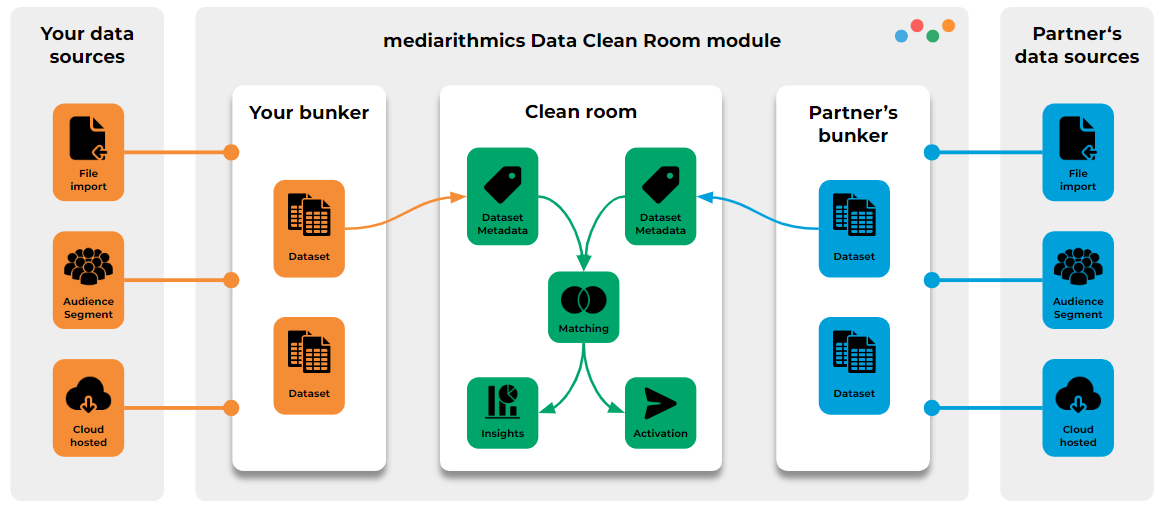
The Data Clean Room module is a secure environment where you and a partner can analyze and share anonymized consumer data without either side compromising the privacy of its own users or handing raw data to the other. It gives you a governed way to determine audience overlap, understand your partner's audience, activate on shared or exclusive users, and measure the results of a joint campaign - all without exposing raw personal data. See [Clean Rooms](/collaboration/plan-and-integrate/setup-clean-rooms/clean-rooms.md) for the full model.

<figure><img src="https://1328282722-files.gitbook.io/~/files/v0/b/gitbook-x-prod.appspot.com/o/spaces%2FA53jQEyPfbbnUyaAsTnT%2Fuploads%2Fgit-blob-3bb68ca5841a531e7bb0786bed6cc45f81149243%2Fdata-clean-room-architecture.png?alt=media" alt="Your data sources and your partner&#x27;s flow into their respective Bunkers, then into a shared Clean Room for matching, insights, and activation"><figcaption><p>Each side keeps its data in its own Bunker; only matching results and insights leave the Clean Room</p></figcaption></figure>

{% hint style="success" %}
**Open model**

* **Not using mediarithmics as your CDP?** The Data Clean Room module is also available on its own.
* **Already a mediarithmics CDP customer?** You can invite partner organisations to collaborate with you in a Clean Room without them needing their own mediarithmics CDP.

Contact your Account manager to find out more.
{% endhint %}

## Other ways to collaborate

Data Clean Room is not the only collaboration model mediarithmics offers:

| You want to                                                                                                     | Model                                 | Where it is documented                         |
| --------------------------------------------------------------------------------------------------------------- | ------------------------------------- | ---------------------------------------------- |
| Run marketing and monetisation use cases with a partner **without sharing your data**                           | **Data Clean Room**                   | This section                                   |
| Consolidate several of your own organisations into a parent                                                     | **Cross-CDP**                         | The `Setup & Monitor` section, under Cross-CDP |
| Share audience segments directly between entities, in the same group or across groups, both using mediarithmics | **mediarithmics Shared Segment feed** | The `Connectors` section                       |

If your partner is external and you both need to keep your respective raw data private, Data Clean Room is the model built for that. If the entities involved are all your own organisations, or if the recipient is another mediarithmics customer you are willing to send a segment to directly, one of the other two models is a better fit.

## The three jobs

<table data-view="cards" data-search="false"><thead><tr><th></th><th></th><th data-hidden data-card-target data-type="content-ref"></th></tr></thead><tbody><tr><td><strong>Plan &#x26; integrate</strong></td><td>Frame your partnership, and understand where your data is stored, how a partnership is structured, and its privacy guarantees.</td><td><a href="/collaboration/plan-and-integrate/frame-your-dcr-project.md">Frame your DCR project</a></td></tr><tr><td><strong>Prepare your environment</strong></td><td>Configure a Clean Room Template, create your first Clean Room, and share your datasets.</td><td><a href="/collaboration/prepare-your-environment/manage-your-clean-room-templates.md">Manage your clean room templates</a></td></tr><tr><td><strong>Collaborate with a partner</strong></td><td>Analyze overlap, activate matched users, and measure joint campaigns.</td><td><a href="/collaboration/collaborate-with-a-partner/analyze-cross-partner-behavior.md">Analyze cross-partner behavior</a></td></tr></tbody></table>

{% hint style="info" %}
Every aggregated result you or your partner see through a Clean Room - a match rate, an insight, an activation count - is protected by differential privacy, not computed from raw data. See [Security and privacy](/collaboration/plan-and-integrate/setup-clean-rooms/security-and-privacy.md).
{% endhint %}


---

# Agent Instructions
This documentation is published with GitBook. GitBook is the documentation platform designed so that both humans and AI agents can read, navigate, and reason over technical content effectively. Learn more at gitbook.com.

## Querying This Documentation
If you need additional information that is not directly available in this page, you can query the documentation by asking a question.

Perform an HTTP GET request on the following URL with the `ask` and `goal` query parameters:

```
GET https://docs.mediarithmics.io/collaboration/readme.md?ask=<question>&goal=<user_goal>
```

`ask` is the immediate question: it should be specific, self-contained, and written in natural language.
`goal` is what the user is ultimately trying to achieve, the reason they need the answer. Sharing it helps GitBook give you a better, more relevant answer. A goal is most helpful when it describes the outcome the user wants rather than restating the question. For example, with `ask=how do I create an API token`, a goal like `automate deployments from our CI pipeline` lets GitBook tailor the answer to that use case.

The response will contain a direct answer to the question and relevant excerpts and sources from the documentation.

Use this mechanism when the answer is not explicitly present in the current page, you need clarification or additional context, or you want to retrieve related documentation sections.
